23 February 2012

Project Hope

Rooftop Hope
Over the last few weeks I've started looking photographically and visually at the theme of Hope in my community and surroundings. The approach is twofold. Firstly I want to capture sources and places of hope that already exist, especially if perhaps they aren't always recognised as such. The second aim is to actively instigate and generate hope. I realise this second objective is quite a tall (and potentially arrogant!) order to set, but I really believe in it. 
Hope in a truck

So far the approach has been a literal one. I'm seeking to quite literally put the word HOPE into the mix around the place. So I'm setting off armed with a set of wooden letters that someone kindly carved for me for this exact purpose and I'm placing them around Bulawayo and photographing them in situ. There's something about actually seeing places in Bulawayo physically alongside, or through, the letters of the word HOPE that is exciting and encouraging. And while the idea is not necessarily ground-breaking (or especially subtle!) in approach, I'm finding getting on and doing it with fun and boldness to be a positive experience. More importantly of course it's the symbolism of the gesture that is meaningful.

In terms of how to achieve this second objective, the basic moto is the more creative the better! And I'm very much in the opening stages – I know there's plenty more creative ways to demonstrate and capture hope which I want to try out for myself but more importantly see others doing too.

Hope Over Bulawayo
Fabric of Hope
The bigger picture is that this be a truly collaborative endeavour and journey. So I'm getting the ball rolling myself so that it's not just theory I talk of, and I'm sharing with people who also carry and see the vision of a Bulawayo full of Hope. And in time I hope that it will also be something that others, who don't necessarily share that view at the moment,  can also engage and experiment with. And who knows what that may look like!
Add caption
These are some of the first images in the series that I have shot for the project.

11 February 2012

I've got an idea...

Am in the opening stages of what I think is going to be an exciting project as well as quite an adventure.  Not sure where it will lead, but so far so good, and I suspect there's lots more in store.
It began as a friend told me how he and his girlfriend gave each other homemade presents at Christmas and he and his camera went looking for shapes and structures in London which could be put together into a picture forming the letters of the word HOPE.  The idea caught my imagination.

hope

Pronunciation:/həʊp/
 noun
  • a feeling of expectation and desire for a particular thing to happen
  • a person or thing that may help or save someone
  • grounds for believing that something good may happen
  • archaic a feeling of trust:

verb
  • To want something to happen or be the case
Something about going looking for hope, figuratively and literally, carving it out even, and interpreting surroundings through a lens of hope.  Hope is something I often think about, especially in relation to life in Zimbabwe.  Much of my time over the last four years has been about looking for and recognising the stories and seeds of hope in this place.  Even if they are buried or trapped amongst other, less hopeful, situations.   A treasure hunt of sorts, with clues along the way.  

I've reflected on hope as a commodity - an ingredient for getting ideas and plans off the ground.  I've wrestled with it's absence, encountered hopelessness, battled and not always won.  I've watched where hope is either in short supply or somehow seems overdone.  Is hope naive? Sometimes it seems so.  I see different types of hope and hoping.  The stakes vary and I have greater appreciation for a hope which hopes in spite of, rather than in denial of, circumstance.  Quiet hope, with doubt not always a stranger, the paradox of carrying both hope and doubt simultaneously.  Costly? That I've also reflected on.  I see the way that, like a floating object thrown in deep water, hope can climb to the surface, challenging circumstance.  I see the difference it can (and does) make.  

Is hope is a choice, a decision?  We choose to see it, to interpret it within the mix, to look for and call it out even.  Is hoping hard...too hard? What if we sometimes can and sometimes just cannot muster it? How does it work and how and where is it generated.  How do you  recover from hopelessness and get your hope back?  Are some just more hopeful than others? I love such questions, as I think they are so real and honest and really matter.  
One way or another, I've come to have a lot of time for Hope: Small word, Big potential.  

I'm looking to turn some of these ideas and experiences into a photographic project of my own.   The medium of photography seems a good fit, considering it's all about ways of seeing and how and what you see.  Capturing hope in the everyday.   Actually, once I started chatting a bit about the idea with others I didn't want it to be just me on my own, so I've made a start towards turning it into a wider effort, open to all.  A challenge of sorts.  Put the HOPE back into Bulawayo...or, maybe just recognise it where it's been there all along, and celebrate it.  Telling the stories of hope.

    07 February 2012

    Rainstorm at Precious Life

    Watching cartoons
    Everyone loves a bit of Tom & Jerry
    With thanks to our sponsor!
    These pictures were sent to Toshiba today, forwarded to their PR department, together with a little story of how one of their laptops is being used for the women and children at Precious Life to watch cartoons during one of my weekly visits to do activities together.  I explained how these small things are part of a bigger picture, one of positive changes in peoples lives and of social transformation through empowerment and practical support and care.  Stories of hope, laughter and fun, from under a leaking roof in the middle of a thunderstorm, on a remote farm with no electricity.  It's such a privilege to be part of it.
    Collecting the drips

    11 December 2011

    Precious Life Foundation

    Princess her daughter Luba with the Precious Life Farm in the background
    One of the highlights of the last few months has been my involvement with The Precious Life Foundation. Started by Agnes Kwenda (who I first met as a physio when she tried to 'relocate' my dislocated finger last year!) Precious Life helps vulnerable women and babies. Started as a response to several cases of baby-dumping, Agnes and her husband Ronald began trying to address some root causes that may lead a pregnant girl to abandon her child. Some of the girls may work as prostitutes, others may have been abused – there are a variety of reasons. The Kwenda's discovered that often a small and simple intervention may be all it takes to persuade someone to think twice about abandoning a baby.

    Precious Life runs a drop-in centre, which offers advice and practical support such as clothing and nappies. It also finds and provides training opportunities for young mothers with a view to giving them a source of livelihood to help them provide for their child.

    The aim is for a self-sufficient project which gives the girls alternative options through education and employment opportunities. It's very practical in approach as Agnes puts her entrepreneurial and business abilities to good use. Small-scale agricultural projects and other vocational skills such as sewing, hospitality, beautician and hairdressing skills have been taught to girls via the drop-in centre.

    Another branch of Precious Life is for deeper engagement with some of the girls, especially those who are victims of abuse and tragic circumstances. In some cases girls need to get out of an abusive situation and sometimes need help finding somewhere else to live. The Kwenda's have hosted several girls and babies themselves, but as numbers rose they looked for other medium to longer term solutions. This is how a small residential community came about and in August this year 8 girls moved to a newly bought farm 20 kilometres out of Bulawayo (on the Johannesburg road).
    Precious Life farm: view from the next door property

    The house at the farm
    It's this group that I've been more involved with over the last couple of months. From a variety of backgrounds and with varying levels of education, the 8 girls are currently living on the farm which has plenty of potential and plans, but at this stage is still quite basic.  20 kilometres from the city and not much established yet, boredom can be one of the battles!

    Agnes Kwenda (3rd from left) with the residents of Precious Life
    I offered to get involved and agreed to spend time with and befriend the group. So I've become a regular visitor and always take some kind of activity for us to do together. I'm getting to know the girls and their children and trust is growing.

    Together we've done manicures, made bracelets, iced biscuits and made paper-chains.  It's far more than just an activity - it's the time interacting and sharing, building relationship and investing.


    Pretty hands
    Our mobile salon


    Making friendship bracelets


    Making Paper Chains


    Icing biscuits


    Sampling the handiwork!

    Beautiful nails
    At a deeper level, I really believe in the importance of taking an interest in others and the power of sharing stories and journeying together. If I can be there in some way for these girls, listening and sharing, teaching and learning, laughing, encouraging and advocating on their behalf, then I will do so and consider it a privilege. I love using creativity and doing creative art/craft things in such a context.  It adds another dimension to having fun and spending time together and can provide a way for the girls get a sense of achievement and encouragement. Precious Life is a very practical and completely grass-roots orientated initiative. All ideas of activities I could do with these special ladies gratefully received!

    Hope you enjoye some pictures of things we've done so far... We've had a lot of fun!

    13 October 2011

    News coverage

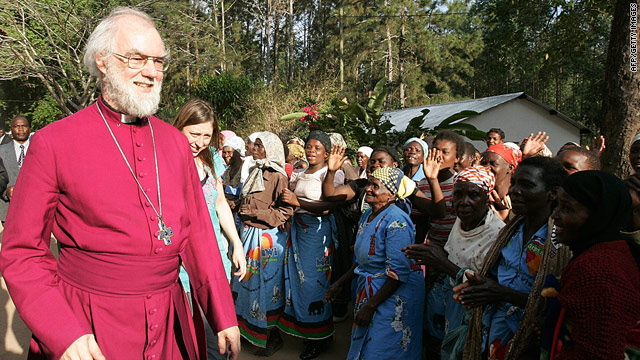
    Robert Mugabe meets Archbishop Rowan Williams


    Here's a link to a piece of CNN coverage that happens to show a glimpse of Helen & I during the main event on Sunday at City Sports Centre, Harare! 
    My Take: Archbishop goes where Western leaders won’t


    A few more articles on the visit...

    CNN/THEOS: My Take: Archbishop goes where Western leaders won’t
    Reuters: Archbishop of Canterbury denounces attacks on Zimbabwe church
    BBC: Archbishop delivers message of hope to Zimbabwe
    BBC: Archbishop of Canterbury on 'healing' Zimbabwe trip
    Sky News: Archbishop And Mugabe Meet In Zimbabwe

    The view of the 18000 crowd at The City Sports Centre

    In the thick of it with Helen Stawski, The Archbishop of Canterbury's Programme Co-ordinator for International Development

    View from the motorcade after being transported with police escort through the streets of Harare


    10 October 2011

    The Archbishop of Canterbury's visit to Zimbabwe

    Historical scenes yesterday from the heart of the City Sports Centre in Harare as The Archbishop of Canterbury, together with other leaders and dignitaries, addressed Zimbabweans during his visit here and to other surrounding countries within the Anglican Province of Central Africa.  It was moving to witness the show of solidarity and support to people of faith who have faced much adversity and opposition and against whom violence and threats have been levelled.  In a society where daily life often seems to warrent navigation through many a shade of grey, and moral and ethical dialemas can blur through their complex layers, it could seem a hopeless or unsurmountable challenge to question the powers that be.  Compliance can seem a far easier path than challenge, yet something surely dies in the very acceptance.  So it was pertinant to hear such core values as justice, freedom, equality and provision for the vulnerable within society, be spoken of, not lightly but as costly and weighty, to stand out from other negative human qualities that have played a huge role here.  I found it so refreshing to be reminded of the bigger picture and to lift our eyes to that again.  Here is the text of the sermon given. 

    05 May 2011

    Othello at HIFA

    Here's the entry about our show: The Gospel of Othello from the Harare International Festival of Arts website.


    The Gospel of Othello


    Just arrived back in Bulawayo from HIFA...more from me about the show soon!